The Routledge Handbook of Geospatial Technologies and Society

Book cover: The Routledge Handbook of Geospatial Technologies and SocietyOut this week: The Routledge Handbook of Geospatial Technologies and Society (Routledge), a collection of essays edited by Alexander J. Kent and Doug Specht. “Contributors reflect on the changing role of geospatial technologies in society and highlight new applications that represent transformative directions in society and point towards new horizons. Furthermore, they encourage dialogue across disciplines to bring new theoretical perspectives on geospatial technologies, from neurology to heritage studies.” Via Matthew Edney, who’s got a chapter in it on pre-1884 geospatial technology. Amazon (Canada, UK), Bookshop.

Kent previously co-edited The Routledge Handbook of Mapping and Cartography (Routledge, 2017) with Peter Vujakovic (previously), and co-authored The Red Atlas (University of Chicago Press, 2017) with John Davies (my review).
Maps Reveal Extent of Land Privatization in Traditional Territories

New maps show the extent to which the Saskatchewan government has been privatizing or leasing public land near indigenous reserves. First Nations in the province are unhappy to discover that those lands—the subject of ongoing negotiations with the government—are no longer available for their traditional use. CBC Saskatchewan has the story (also see video above; the centre responsible for the maps has not posted them online).

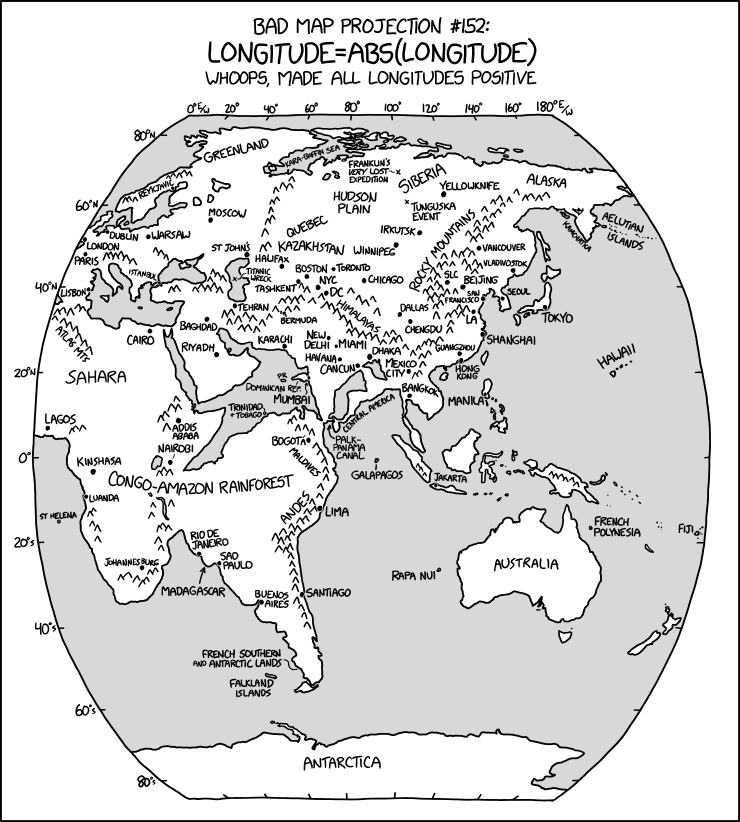
‘Whoops, Made All Longitudes Positive’

xkcd:Bad Map Projection: ABS(Longitude)
Randall Munroe, “Bad Map Projection: ABS(Longitude),” xkcd, 26 Jul 2023.

The latest in Randall Munroe’s Bad Map Projection series on xkcd is perhaps his most evil yet: it turns all longitudes positive—i.e., it turns west longitude into east longitude, putting Quebec somewhere in Kazakhstan and the Panama Canal off Sri Lanka.

The Aftermath of the Kakhovka Dam’s Destruction

A pair of Landsat images showing the drainage of the Kakhovka Reservoir in Ukraine after the Kakhovka Dam was breached on 6 June 2023.
Kakhovka Reservoir on 7 June 2022 (top) and 18 June 2023 (bottom). Landsat 8/OLI and Landsat 9/OLI-2, respectively. NASA Earth Observatory/USGS/Lauren Dauphin.

NASA Earth Observatory has before-and-after satellite imagery showing the impact of the destruction of Ukraine’s Kakhovka Dam last month. The Kakhovka Reservoir is emptying out (above), the irrigation canals that relied on that reservoir are drying out, and there was flooding downriver of the dam in the immediate aftermath of the breach.

Apple Maps Roundup for July 2023

Downloadable maps are coming to Apple Maps in iOS 17 this fall. Ars Technica looks at how they’ll work, and how they’ll compare to Google Maps’ offline maps (at the moment—which to be sure is with the iOS 17 public beta—Apple’s offline maps take up much more space but also offer more detail).

James Killick considers Apple’s forthcoming Vision Pro headset and wonders whether something might not be afoot in the mapping space. “The real kicker for geospatial is its ability to immerse you in a truly 3D experience. […] So given a truly immersive 3D experience is possible, think of the wonders it will do for maps and mapping in general.”

After expanding its new maps to central Europe—Austria, Croatia, Czechia, Hungary, Poland and Slovenia—in April, Apple brought detailed city maps to Paris, cycling directions to the whole of France, and its new maps to Hong Kong, Taiwan and Slovakia in June. As usual, Justin O’Beirne has all the details at the above links.

California (Mapped by) Typewriter

A typewritten elevation map of California by R. J. AndrewsAnything mashing up maps and typewriters is guaranteed to get my attention (I have 37 of the latter and rather a lot more of the former). So I have no choice but to share R. J. Andrews’s “Typewriter,” an elevation map of California created on a manual typewriter.

Created by layering combinations of nearly 2,500 keystrokes (I, H, X, and O) with a 1953 Royal Quiet De Luxe typewriter on Masa 77gsm paper from Japan. Based on a California Albers projection at approximately 1:5,000,000 scale.

The original is held by the David Rumsey Map Collection.

The Materiality of Maps

Fresh from a course on the materiality—“i.e. the physical characteristics of maps: size, paper, format, printing method, color, etc.”—of maps, the Library of Congress’s Amelia Raines explores a few maps from her home state of Michigan in terms of the production methods behind them, and the context in which they were published (e.g. as part of a book).

Geographical on the NYC Subway Map Debate

Geographical magazine has a short history of the New York City subway map and its controversies. This has been a fraught and hotly contested topic for most of the last 50 years, and Jules Stewart’s article can’t go into nearly enough depth to capture it all, but it could serve as a decent entry point for those not in the know. Drawing rather heavily on the expertise of Peter Lloyd (previously), Stewart covers the subject from the first subway maps to where the MTA goes from here.

Previously: A Naïve Look at New York’s Subway Map.

Philippine Censors Want ‘Barbie’ Blurred, Not Banned

The Philippines is just as keen as Vietnam is to ban films showing the nine-dash line, and has done so in the past. Nevertheless, the Philippine censor board has decided to allow the release of the forthcoming Barbie movie, but has asked Warner Bros. to blur the offending map, which is apparently only eight dashes (and therefore okay) and too cartoonish to be linked to a controversial line on a real map. Coverage: BBC News, Guardian, Hollywood Reporter, Variety.

That follows the Warner Bros. line; last Thursday Variety reported the Warner Bros. response to Barbie being banned in Vietnam: “‘The map in Barbie Land is a child-like crayon drawing,’ a spokesperson for the Warner Bros. Film Group told Variety. ‘The doodles depict Barbie’s make-believe journey from Barbie Land to the “real world.” It was not intended to make any type of statement.’”

(Based on the screenshots I’ve seen, all it is is a dashed line extending east from a wildly inaccurate Asia; there are dashed lines elsewhere on the map that suggest routes more than borders.)

The Deepest Map

Book cover: The Deepest MapOut today from HarperCollins (and Goose Lane in Canada): The Deepest Map: The High-Stakes Race to Chart the World’s Oceans by Laura Trethewey. “Scientists, investors, militaries, and private explorers are competing in this epic venture to obtain an accurate reading of this vast terrain and understand its contours and environment. In The Deepest Map, Laura Trethewey chronicles this race to the bottom. Following global efforts around the world, she documents Inuit-led crowdsourced mapping in the Arctic as climate change alters the landscape, a Texas millionaire’s efforts to become the first man to dive to the deepest point in each ocean, and the increasingly fraught question of whether and how to mine the deep sea.” Amazon (Canada, UK), Bookshop.

Map Men on Why North Is Up

The latest episode of Jay Foreman and Mark Cooper-Jones’s all-too-infrequent series Map Men looks at why north is at the top of modern maps, and features examples of maps where this was, or is, not the case, and why.

For something a bit more … academic, see Mick Ashworth’s Why North Is Up: Map Conventions and Where They Came From (Bodleian, 2019).

Previously: The Origins of North at the Top of Maps; The Idea of North.

The Nine-Dash Line Strikes Again!

Netflix has removed Flight to You from its service in Vietnam, Variety reports, because the Chinese drama has scenes in nine episodes that show the nine-dash line on a map. The nine-dash line depicts China’s territorial claims in the South China Sea, which Vietnam (among other countries) bitterly contests—to the point of banning depictions of said line in all media.

Previously: The Nine-Dash Line Gets ‘Barbie’ Banned in Vietnam.

History of Cartography Project’s Fourth Volume Now Available Online

The History of Cartography Project’s fourth volume, Cartography in the European Enlightenment, is now available online for free download in PDF format. This book, edited by Matthew Edney and Mary Sponberg Pedley, came out in hardcover in the depths of the pandemic; free online access a few years after publication follows the precedent of previous volumes in the series.

This means that all five volumes that have been published to date can be downloaded for free (here). The remaining volume—volume five, Cartography in the Nineteenth Century—is in preparation. When that final book is published, it will close out a project that has taken more than four decades to come to fruition.

Previously: Forty Years of the History of Cartography Project; The History of Cartography’s Fourth Volume, Now (Almost) Out; History of Cartography Project Updates.