
Maps Mania reported last month that the University of Virginia’s Racial Dot Map has been taken offline. The proximate causes: the 2020 census, which rendered the map obsolete (it was based on 2010) data; the increased complexity of the 2020 census’s racial data (more people IDing as multiracial or other); and insufficient resources to bring the map up to date given that complexity. But Maps Mania points to a number of new racial dot maps, such as CNN’s and Ben Schmidt’s All of US, which operate despite the caveats identified by UVa; plus see the following previous posts: Census Mapper: An Interactive Map of U.S. Population Changes; Mapping Racial Population Shifts in the United States.
Topsy-Turvy: The London Underground in the Style of the New York Subway Map

Plenty of cities’ subway maps have been reimagined in the style of the London Underground map. Cameron Booth, for example, has redone New York’s subway map in that style. But a map posted by a graphic designer named Sean to Reddit does the exact opposite: it reimagines the London Underground map in the style of New York’s subway map. Bringing the design language of Michael Hertz to Harry Beck’s sovereign territory is probably blasphemous in some quarters, but as a pastiche of the New York style? Cameron says: “Sean has absolutely nailed the New York Subway map style, and perhaps even improved upon it in places—I note with pleasure that all of his station labels are set horizontally, instead of the many varied angles used on the official NYC map.” His bottom line? “One of the best style mash-ups I’ve seen: technically excellent, well-researched and actually really informative. Wonderful!”
It’s available as a print on Etsy, because of course it is.
Mercator: Extreme
To follow-up on xkcd’s Madagascator cartoon (previously), I missed the fact that clicking on the cartoon at the xkcd website actually did something, but Keir caught it: it links to Drew Roos’s Mercator: Extreme, an online tool that allows you to have some fun with the Mercator projection’s excessive polar distortion by making any point on the planet the North Pole and which clearly served as Randall’s inspiration.
Pictorial St. Louis

On the Library of Congress’s map blog, World’s Revealed, Julie Stoner takes a look at a rather unusual example of a bird’s-eye (or panoramic) city map. “The Geography and Map Division has over 1,700 of these beautiful panoramic maps in the collection, but one item stands out above all the others as one of the crowning achievements of the art, Camille N. Dry’s 1875 atlas, Pictorial St. Louis; The Great Metropolis of the Mississippi Valley. A visually stunning atlas, instead of only one sheet, it was produced on 110 plates, which if trimmed and assembled creates a panorama of the city measuring about 9 by 24 feet.”
xkcd’s Madagascator Projection
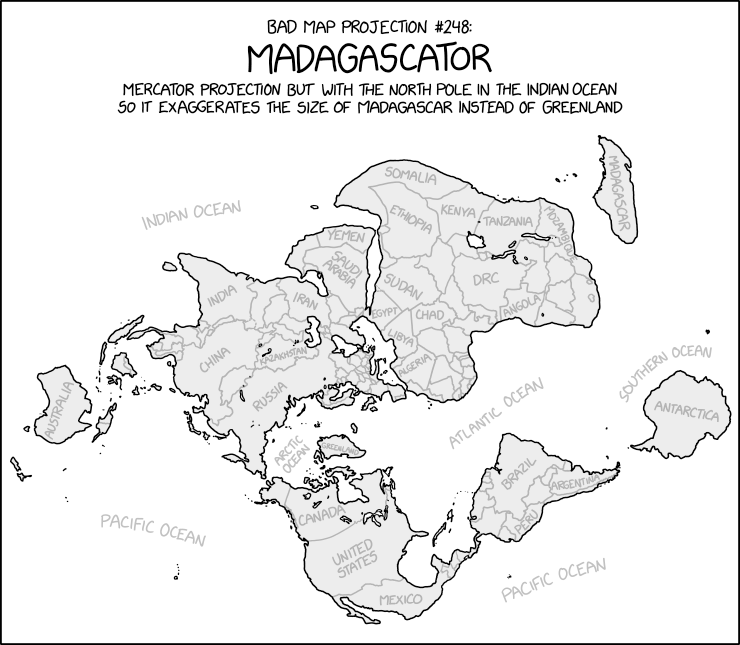
Uncharacteristically for xkcd’s Bad Map Projection series, the Madagascator is actually totally legitimate as a projection. Not that it’s any less mischievous, mind.
Update, 3 May: Turns out there was more to this xkcd cartoon. See Mercator: Extreme.
Updates to Maps of Historical Earthquakes, Tsunami and Volcanic Eruptions

Every two years or so, NOAA’s National Centers for Environmental Information updates poster maps based on its Global Historical Tsunami, Significant Earthquake and Significant Volcanic Eruption databases; the 2022 editions are now available. The posters, made in collaboration with the International Tsunami Information Center, are distributed to emergency response personnel; they provide a historical overview of where earthquakes or eruptions took place, or tsunami originated, going back literally millenia. The maps can be downloaded in PDF format: Significant Earthquakes 2150 B.C. to A.D. 2022, Tsunami Sources 1610 B.C. to A.D. 2022, and Significant Volcanic Eruptions 4360 B.C. to A.D. 2022.
The Gough Map and Its Ghostly Predecessor

An update on the Gough Map Project from Bill Shannon. “The Gough Map Project has reached that ‘interesting’ stage where we are moving from either sitting on the fence and making no decisions, or making lots, but then rejecting them all. It is now time to reach some firm conclusions, and start writing.”
Among other things, the Gough Map appears to be a copy of, and updated from, an earlier (“ghost”) map:
And so, we now have still more questions as we turn over the possible scenarios. If the copying was done in the early years of Henry IV, when was the Predecessor made? And where? And why? And why was our copy made—and where? And, what about that shipwreck? And, especially, what about those red lines previously interpreted as “roads”: it seems quite clear that these were not on the Predecessor, which means it never was a road map. Indeed, as we have progressed, we have realised those red lines are, at best, routes. […] But one thing we feel sure of: Mr Gough’s map was never a high-quality, show-piece display object; it was a back-room, practical, work-a-day thing.
Previously: Understanding the Gough Map.
A Striped Circle Map of the French Presidential Election Results

Julien Gaffuri’s map of the second-round results of the French presidential election is, as you can see, extraordinarily busy—and, by the way, extremely processor-intensive: it will slow down your machine—because it’s at the commune level and each circle is scaled to population. (News flash: Paris has lots of people in it.) And those circles are striped circles: the proportion of the votes is indicated by the area taken up by a given colour. The map of the first round results shows more stripes (because more candidates) but is by department, so it’s a little easier both to read and to see how the striped circle format works. It’s an interesting alternative to a choropleth map, and a bit less ambiguous.
Strange Maps on Perception Maps
Over on Strange Maps, which like this here site is still a going concern, Frank Jacobs has a nice writeup of the history of perception maps. These are maps that provide a skewed or exaggerated view, usually of the United States, that favours their preferred part of it. The best known is Saul Steinberg’s 1976 New Yorker cover (“View of the World from 9th Avenue”) but there were antecedents. Frank covers the examples I mentioned in these previous entries: McCutcheon’s View; McCutcheon’s 1908 Cartoon. Plus a few others.
Het Grote Kaartenboek (The Great Book of Maps)
 Out today from WBooks: Het Grote Kaartenboek: Vijf eeuwen cartografie [The Great Book of Maps: Five Centuries of Cartography] a book collecting 500 years of maps from the National Archives of the Netherlands. Edited by Ron Guleij, it also features eight essays by guest authors. (In Dutch, naturally.) We’ve seen other map books that focus on the holdings of a specific library or archive: I’m thinking specifically of Debbie Hall’s Treasures from the Map Room (2016), which presented maps from the Bodleian Library, and Tom Harper’s Atlas: A World of Maps from the British Library (2018). This one seems to be taking a look behind the curtain, with material on collection management (assuming Google Translate is not deceiving me).
Previously: The History of the Netherlands in 100 Old Maps.
2022 French Presidential Election (Second Round)
 France 24’s interactive map (right) covers both first and second rounds and shows results by region, department and commune. It is annoyingly unlabelled, which is a surprising choice for France’s English-language news service. Le Monde’s map uses a similar colour scheme—yellow/orange for Macron, grey/brown for Le Pen—but at least has mouseover labels.
Le Parisien’s maps aren’t interactive, nor are they particularly large, but they illustrate other aspects of the results, like the abstentions, voter turnout and differences vs. the 2017 vote. The Guardian’s maps are low on detail but provide similar information. Libération’s map, on the other hand, is a cluttered mess, showing each commune as a proportionally sized dot. [Maps Mania]
Previously: 2022 French Presidential Election (First Round).
Apple Maps Updates: Germany, Singapore and U.S. Cycling Directions
Justin O’Beirne notes that Apple’s new maps—which, remember, were first announced in 2018, so: for certain values of new—have arrived in Germany and Singapore. Also, he observes that Apple is adding cycling directions in roughly the same order the new maps rolled out in the United States: they were added to the Midwest in mid-April, and northeastern states at the beginning of the month.
New Leventhal Exhibition: More or Less in Common

More or Less in Common: Environment and Justice in the Human Landscape is the latest exhibition at the Boston Public Library’s Leventhal Map and Education Center.
In More or Less in Common: Environment and Justice in the Human Landscape, we take a look at how questions of social justice and injustice are essential topics to confront when trying to understand the human landscape. These questions must also be at the center of our attention as we challenge ourselves to build better, healthier environments in the future. Through maps as well as photographs, images, and data visualizations, this exhibition encourages you to confront stories about how environmental conditions have sometimes served to worsen inequalities along lines of social division. At the same time, our shared environment offers the possibility to bring people together across differences and the inspiration to forge new kinds of common action.
This is a hybrid physical/digital exhibition that can be visited in person or viewed online. It opened on March 18 and runs until December 28. See the Boston Globe’s coverage.
Spacecraft Will Test Satnav Reception from Lunar Orbit
More on the astonishing idea that Earth-orbiting GNSS satellites can be used for navigation at the Moon. The European Space Agency reports that among the instruments carried by the upcoming Lunar Pathfinder commercial mission will be a 1.4 kg satnav receiver that will test its ability to receive GPS and Galileo signals from lunar orbit. “Satnav position fixes from the receiver will be compared with conventional radio ranging carried out using Lunar Pathfinder’s X-band transmitter as well as laser ranging performed using a retroreflector contributed by NASA and developed by the KBR company.” Lunar Pathfinder is currently scheduled to launch in 2024.
Previously: Many Moon Maps; Can GPS Be Used on the Moon?
The Quarantine Atlas
 Out today from Black Dog & Leventhal: The Quarantine Atlas, a book-length distillation of CityLab’s COVID-19 mapping project, in which they solicited readers’ hand-drawn maps of life under lockdown, the year 2020 in general, and how life has been changed by the pandemic. They received more than 400 submissions; 65 of those maps, plus essays by divers hands, are included in the book.
To mark The Quarantine Atlas’s release, editor Laura Bliss has a piece in Smithsonian adapted from the book’s introduction and generously illustrated with maps. Bloomberg, which absorbed CityLab a while back, features twelve quarantine maps from the various calls for submissions. Update: Plus an adaptation of David Dudley’s foreword.
 The Quarantine Atlas
by Laura Bliss
Black Dog & Leventhal, 19 Apr 2022
Amazon (Canada, UK) | Apple Books | Bookshop