Alexander Pescud spent more than 500 hours drawing the Wollongong Map, a black-and-white panoramic map of the Australian city of Wollongong. I’ve been told that the map will have its official launch on 22 June at the Gong’s Bad News Gallery. Prints are available for sale, naturally.
Pierre Novat, French Painter of Ski Resort Panoramas
Pierre Novat (1928-2007) was another painter of panoramic mountain and ski resort maps working with the same techniques as Henrich Berann and James Niehues. Novat actually predates Niehues, and even Niehues’s mentor Bill Brown: his career ran from the early 1960s until his retirement in 1999. He mainly focused on French ski resorts; for the 1992 Winter Olympics in Albertville he pained a panorama of all the Savoie venues. In March 1992, France 3 aired this profile of Novat that explored his process; the above video relates to a 2014 exposition of his work. (All links in French; see this 2014 blog post from the Ski Adventures blog for something in English.)
Fire and Smoke Forecast Maps
Last week my location was blanketed by smoke from forest fires in northern Quebec, with the air quality index pegged as high as it goes (which is to say, eleven). The iPhone’s default weather app has an air quality map that I made use of—you could actually see the fire hotspots—but there are other wildfire maps out there. For example: NOAA’s experimental interactive map based on its HRRR-Smoke model; AirNow’s Fire and Smoke Map; and the interactive smoke forecast from FireSmoke Canada. [Maps Mania]
The Map Books of 2023 page is finally live. I typically have it up closer to the start of the year, but this hasn’t been a typical year, so it’s taken a while to get to. As always, please let me know if you know of a book that came out or is coming out this year—anything to do with cartography, maps or a related subject—that ought to be listed on this page; I’ll need a publication date and something to link to.
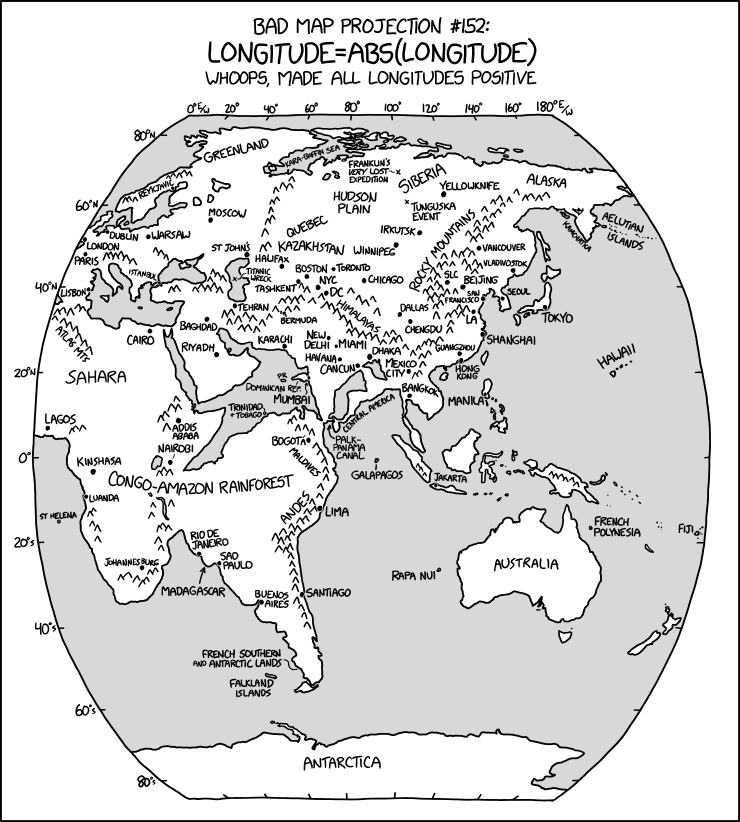
xkcd’s Drainage Basin Deep Cut

This xkcd cartoon requires deep Nickelodeon knowledge to understand.
The Lost Art of Map Reading
“The physical map has the same appeal, probably, as the vinyl record. It’s tactile, it’s there, it’s present—it’s not ephemeral.”
A nice piece from CBC News on the so-called lost art of map reading and paper maps, touching many of the usual points, featuring (among others) the co-owners of my local map store, Ottawa’s World of Maps.
The Great Globe Conspiracy
Hoo boy. Globes are everywhere and proof of round-earther brainwashing: that seems to be the point of view of Kandiss Taylor, a former Republican candidate for Georgia governor and recently elected GOP district chair who apparently went full flat-earther in a recent podcast episode. See coverage from Gizmodo, Rolling Stone and Salon.
Bellerby and the History and Craft of Globemaking
Profiles of premium globemaker Bellerby and Company aren’t exactly scarce, but this one from Geographical magazine is worth a read for its focus on the craft of making globes and its history, and where Bellerby fits into it.
Mapping Anti-Trans Legislation Risk

There has been an outbreak of anti-trans legislation at the state level in the United States, and Erin Reed has spent the last three years tracking it. Her anti-trans legislative risk map measures the extent to which trans people are endangered by such legislation, whether it’s already on the books or could be the offing before the next election. The map reveals, no surprise, a polarized America: one where some states are racing to put anti-trans laws on the books while others enact protections and set themselves up as safe harbours.
Previously: Mapping Safe Washrooms.
European Night Train Network Map

Night train advocacy group Back on Track has a map showing the current network of European night trains offered by various train operators. It’s colour coded by operator, but individual lines are a bit hard to follow, and using various dashed lines for both less-than-daily service and forthcoming service is a bit confusing. Then again, given the sharp uptick of night train services being offered, it’s almost unavoidable that any map of this sort will be a bit of a jumble: compare with Jug Cerović’s version (previously) to see what I mean.
Leventhal’s Urban Atlas Explorer Atlascope Is Expanding, Seeking Sponsors

Speaking of georeferencing old maps, the Leventhal Map Center at Boston Public Library has a collection of late 19th- and early 20th-century urban atlases. Their Atlascope platform presents 101 of them in a web interface overlaid on a modern street map. The Leventhal is now looking to expand Atlascope’s coverage beyond the Boston area to towns and counties across Massachusetts, and is raising funds to do so (it can apparently take 60 hours to process one atlas). Details on sponsoring an atlas here. See their Instagram post.
GeoTIFFs Explained

The blog of the Library of Congress’s Geography and Maps Division isn’t the first place you’d expect an explanation of the GeoTIFF format (basically, an image file in TIFF format that includes georeferencing metadata, so that the image can be projected on a map grid). But georeferencing old maps so that they can be placed on a modern map grid is definitely a thing, and Carissa Pastuch’s piece, “The Secret Life of GeoTIFFs,” looks at GeoTIFFs through the lens of an experimental dataset of georeferenced late 19th- and early 20th-century Austro-Hungarian maps.
New Podcast: Very Expensive Maps
Very Expensive Maps “is a podcast by cartographer Evan Applegate in which he interviews better cartographers.” His interviewees include names that should be quite familiar to my regular readers. In just over three weeks there have already been 14 episodes uploaded, which is kind of incredible.
Bakhmut in Satellite Imagery
CNN: “Before-and-after satellite imagery below shows the damage done to the hard-hit eastern Ukrainian city of Bakhmut over the past year.”
Mapping Russia’s Military Presence in Crimea
Journalists working for Radio Liberty’s Crimean Realities project have released an interactive map of Crimea showing the location of more than 200 Russian military facilities. It’s meant as a warning to residents: these are the areas you need to stay away from. In Russian and Ukrainian only. News coverage: Radio Svoboda (Ukrainian; Google Translate), Ukrainska Pravda (English), Newsweek. [Maps Mania]