
Privacy-focused search engine DuckDuckGo, which added Apple Maps to its search results in early 2019, has taken the next step and added walking and driving directions to those maps. Like the maps, the directions use Apple’s MapKit JS framework. [Daring Fireball]
Category: Mobile
Apple and Google Maps Updates
Apple Maps
- AppleInsider looks at how cycling directions work in iOS 14.
- Macworld provides a primer on how to correct errors and add features in Apple Maps.
- Apple’s new maps have now officially launched in Ireland and the United Kingdom (previously).
Google Maps
- Google’s official blog details updates to Live View, Google Maps’s AR feature that superimposes walking directions on the view through your phone’s camera (previously).
- A primer on how Google Maps acquires and processes satellite and aerial imagery, also from Google’s official blog.
- Google Maps has a Nazi problem, says Mike Shaughnessy: the service’s inadequate review moderation and its poor handling of memorials (whichit expects to act as businesses) provide an inadvertent platform “for Nazi veneration and Holocaust jokes.”
An Apple and Google Maps Roundup

Google Maps is now available on the Apple Watch as of version 5.52 of the iPhone app. Meanwhile, more is emerging about the behind-the-scenes mapping efforts of both Google and Apple. Google is using machine learning to predict traffic flows and improve ETA estimates (Engadget, The Verge). More prosaically, 9to5 Mac looks at how Apple collects street data, down to the software, computer hardware and make of car used.
Apple Maps Updates in Ireland, Japan and the U.K.
Justin O’Beirne reports that Apple is now testing its new maps for the United Kingdom and Ireland: the maps are available for a small subset of users. [AppleInsider, MacRumors]
Apple’s maps of Japan have also been updated—like the Look Around updates, this was probably originally intended to coincide with the Olympics—but O’Beirne concludes that the data comes from a third-party provider: the maps have even more detail than Apple’s U.S. maps in some cases, less detail in others.
Google Adds Colour and Detail to Its Maps

Google has added a splash of colour and detail to its larger-scale map layers, using a “color-mapping algorithmic technique” to assign colours to more natural features like forest cover and deserts. “First, we use computer vision to identify natural features from our satellite imagery, looking specifically at arid, icy, forested, and mountainous regions. We then analyze these features and assign them a range of colors on the HSV color model. For example, a densely covered forest can be classified as dark green, while an area of patchy shrubs could appear as a lighter shade of green.” Meanwhile, cities get more pedestrian data, such as crosswalks and sidewalks. [Engadget, The Verge]
Apple’s Look Around Comes to Japan
Ata Distance reports that the Look Around of feature of Apple Maps, which is roughly analogous to Google’s Street View, is now available in the Tokyo, Kyoto-Osaka and Nagoya regions of Japan—it’s presumed that this was intended to coincide with the (now postponed) 2020 Olympics. This is the first implementation of Look Around outside the United States. [9 to 5 Mac/
Garmin’s Slow Recovery from Last Week’s Ransomware Attack
Engadget reports that Garmin’s services are starting to come back online after last week’s ransomware attack:
[I]t looks like things are slowly but surely coming back to life. Yesterday, activity-tracking app Strava confirmed that it was again able to send workout data to Garmin’s Connect service. […] But a quick look at Garmin’s system status page shows there are still plenty of issues across its platform.
Unfortunately, Garmin’s relative lack of communication around these issues means we still don’t know exactly what went wrong or when users can expect things to be back to normal. A few other key services, like registering a new device, are also back up and running, but if you’re still experiencing oddities with your Garmin devices, you’ll have to keep being patient.
Garmin’s FAQ on the outage is not particularly forthcoming.
Previously: Garmin’s Online Services Hit by Ransomware Attack.
Update, 1:48 PM: Garmin has issued a statement confirming that “it was the victim of a cyber attack that encrypted some of our systems on July 23, 2020.” There is no sign that customer data was affected, and they expect a return to normal within a few days. [Engadget]
Apple Maps Updates Coming in iOS 14 This Fall
Updates to Apple Maps announced at WWDC last month include electric vehicle routing, cycling directions, traffic and speed camera notifications, and the ability to derive your location when GPS signals are weak by scanning the buildings in your area (presumably limited to cities with Look Around). In addition, Apple’s new, built-from-the-ground-up map data, which as of last January now covers the entire U.S., will be coming to Canada, Ireland and the U.K. later this year. The updates are a part of iOS 14, which launches in the fall. More at Engadget and The Verge.
Update, 7 Aug: MacRumors has a piece on what’s new in iOS 14 Maps.
Google Maps Turns 15
 Google is marking Google Maps’s 15th birthday with updated iOS and Android apps that reorganize everything into five tabs, new crowdsourced travel data, and a new app icon. (The update hasn’t turned up for me yet, but that’s not unusual.) Also with a fair number of reminiscences and corporate
 navel-gazing self-reflection. CNBC, Engadget, The Verge.
Primers on Google Earth and Google’s Imagery
A nice, accessible (if overboosterish) history and overview of Google Earth—which despite its deprecation on the desktop is still a thing—from Sarvish Mathi at OneZero. [GIS Lounge] Related: this Google blog post on their imagery, how they get it and how it’s processed.
99 Smartphones Create Virtual Traffic Jam
Simon Weckert created a virtual traffic jam in Berlin by pulling 99 used smartphones in a wagon: a large number of phones moving slowly looks like a traffic jam to Google Maps. “Through this activity, it is possible to turn a green street red which has an impact in the physical world by navigating cars on another route to avoid being stuck in traffic.”
Google’s statement to 9to5Google suggests that they’re taking Simon’s hack in stride: “Traffic data in Google Maps is refreshed continuously thanks to information from a variety of sources, including aggregated anonymized data from people who have location services turned on and contributions from the Google Maps community. We’ve launched the ability to distinguish between cars and motorcycles in several countries including India, Indonesia and Egypt, though we haven’t quite cracked traveling by wagon. We appreciate seeing creative uses of Google Maps like this as it helps us make maps work better over time.”
So people fed up with traffic being rerouted onto their residential streets could, conceivably, hack that traffic elsewhere—but not for much longer.
Apple’s New Maps Now Cover the Entire United States
 Last year Apple rolled out its new map data in stages, with new coverage being added on a state-by-state or region-by-region basis. Yesterday Apple announced that its new map data now covers the entire United States (except, Justin O’Beirne points out, the territories). This is slightly later than the end-of-2019 target they’d been aiming for. Europe is scheduled to start receiving the new map data this year.
Matthew Panzarino, who broke the news in 2018 that Apple was building its own map data, said in a tweet that “Maps is probably the biggest software turnaround in Apple’s modern era—an interesting case study for a company that rarely needs turnaround efforts.”
Previously: Apple Maps Data Being Completely Rebuilt for iOS 12; A Look at the Rebuilt Apple Maps; Apple Maps at WWDC 2019: New Map Data, Look Around and More; Apple’s New Map Data Rolls Out Region by Region.
xkcd: Reaction Maps
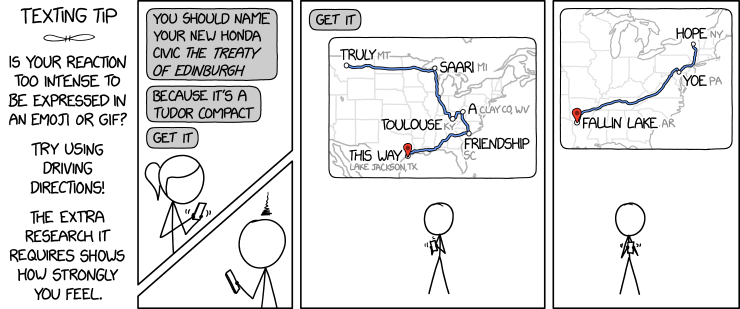
The latest xkcd comic suggests a fiendish way to express yourself: by creating phrases from driving direction waypoints.
An obvious upgrade would be to use one or more of the places from the Magnificently Rude Map of World Place Names (previously).
GPS Units: Still a Thing
Wirecutter’s Medea Giordano argues that even in the age of smartphones with built-in map apps, there’s still a place in your car for a dedicated GPS device: “there are cases when a phone just doesn’t cut it—say, in rural areas where coverage is questionable, or if you simply don’t want to drain your phone’s battery and data plan. Or when you’ve just found it frustrating to use a phone for long trips, like I have.”
Google Maps and Privacy
 Incognito mode for Google Maps, announced last May, is currently in testing. With the mode enabled, user activity isn’t saved to the user’s Google account. It was made available last week to beta testers using the preview version of the Google Maps Android app.
Meanwhile, Strange Maps looks at the curious lack of Google Street View in Germany and Austria, where privacy concerns are paramount.