
In the above video, the Ticket to Know YouTube channel looks at the idea of cartographic generalization—where a map at smaller scale must necessarily remove detail to preserve legibility, to the extent that cities with very large populations (like Baltimore, Guangzhou or Yokohama) get left off the map because they’re near even larger or more significant cities get left off the map. As well as its opposite: where tiny population centres get put on the map because they’re in empty spaces (which maps have always hated). His example is Alice Springs; mine would have been a Canadian Arctic settlement like Churchill, Manitoba, population 870, which tends to appear even on globes.
Category: Cartography
Edney on Arno Peters
Matthew Edney has written a long blog post on Arno Peters and his map.
I’ve been struggling for months now on how to deal with Arno Peters and his world map. Every time I turn to the subject, I just get bogged down by the complexity of the scattered and multifaceted literature, by the insanity of much of Peters’ map work, and by the different responses to his work. […] After at least three tries to say something new, and floundering each time, I am presenting this blog entry simply as an attempt to organize the information about Peters in a way that makes sense to me, which is to say historically. Think of it as a long bibliographical essay based on what I have to hand (so not comprehensive, especially in the German-language literature). I’m not sure that it says anything necessarily new or significant. So please join me as I go through a series of cuts at Peters and his map work.
Field’s Favourites for 2023
Another end-of-year tradition is Kenneth Field posting a roundup of his favourite maps of the year. The 2023 iteration is the usual mix of the very good (e.g. Eric Knight’s Tien Shan and Anton Thomas’s Wild World) and the extremely original, such as Chicago’s L depicted in snake form, or a river map designed for a receipt printer.
Previously: Field’s Favourites for 2022; Maps at Year’s End.
‘Where Comedy Meets Geography’
Geographical magazine has a profile of the Map Men—that is, Jay Foreman and Mark Cooper-Jones, who’ve been posting funny videos on YouTube that explain some cartographical or geographical silliness since 2016, on and off.
‘As little as ten years ago, maps were something that you just had to live with and everybody had an A-to-Z in the car,’ says Jay, who is the main comedic influence behind the channel, having already found success with a series on London’s architecture called Unfinished London. ‘But now that everyone has a sat nav, I think maps have become, for want of a better word, more geeky. You get people who didn’t realise that they were interested in maps or geography until they see an episode of Map Men and they’ll say: “Oh, yeah, maps are my guilty pleasure.” And I don’t think people would have necessarily talked like that about maps ten years ago, because they used to be something that we depended on. And now they have become something that we enjoy.’
(See previous posts.)
Bad Maps, Kindness and Empathy
The 2023 iteration of the 30 Day Map Challenge is coming up, and Daniel Huffman has some thoughts about the day four prompt (“a bad map”) and making room for kindness in the mapmaking community.
It’s fun to play with those things that you’re not supposed to do! But, these are also same kinds of choices that might be made by someone who’s new to our community, and who isn’t as experienced. I’ve seen plenty of students who start out their careers by producing work that is very similar to the material that my colleagues produced when they were prompted to make “a bad map.”
Imagine, then, being one of those novices and seeing someone out there make something in the same style as you, and then see people laugh at it. Might you learn a useful lesson about design? Maybe. But there’s a kinder and more effective way to teach the next generation, isn’t there? […]
It’s no secret that I think our community has had a history of toxic critique and gatekeeping. I’ve written about it here, and talked about it at NACIS. This year, when prompted to make “a bad map,” I invite you to think of “bad” in more ways than just “what a beginner would make.”
Previously: Thirty Day Map Challenge; ‘One Bad Map a Day in February’.
A Book Roundup: Recent New Publications
 Writing for Geographical magazine, Katherine Parker reviews A History of the World in 500 Maps by Christian Grataloup (Thames & Hudson, 13 Jul 2023), which was originally published in French in 2019. “[E]ven with 500 maps, there’s a selection process at work that may leave some readers wanting for specific trajectories and topics. For example, although there’s a continual emphasis on economics, commerce and migration, the impact of the Transatlantic slave trade is only lightly addressed. Similarly, Indigenous perspectives are present, but not abundant. However, such critiques of lacuna in subject coverage are inevitable in any book that attempts to include all of human history.” Note that the maps are modern maps of history created for this book, not old maps. UK-only publication. £35. Amazon UK.
 The 38th volume of the Esri Map Book (Esri, 5 Sep 2023) came out earlier this month. Like the NACIS Atlas of Design (previously),1 it’s a showcase of maps presented at a conference—in this case, maps from the Map Gallery exhibition of Esri’s International User Conference. The Esri Map Book website has a gallery of maps presumably from this volume, and given the number of pages in the book (140) and the number of maps in the gallery (65), it may actually be complete (assuming a two-page spread per map). $30. Amazon (Canada, UK), Bookshop.
 Peter Bellerby, of bespoke premium globemaker Bellerby & Co. fame, has written a book: The Globemakers: The Curious Story of an Ancient Craft (Bloomsbury) is out today in hardcover in the UK, and in North America on October 17; the ebook is available worldwide as of today. From the publisher: “The Globemakers brings us inside Bellerby’s gorgeous studio to learn how he and his team of cartographers and artists bring these stunning celestial, terrestrial, and planetary objects to life. Along the way he tells stories of his adventure and the luck along the way that shaped the company.” £25/$30. Amazon (Canada, UK), Bookshop.
‘Whoops, Made All Longitudes Positive’
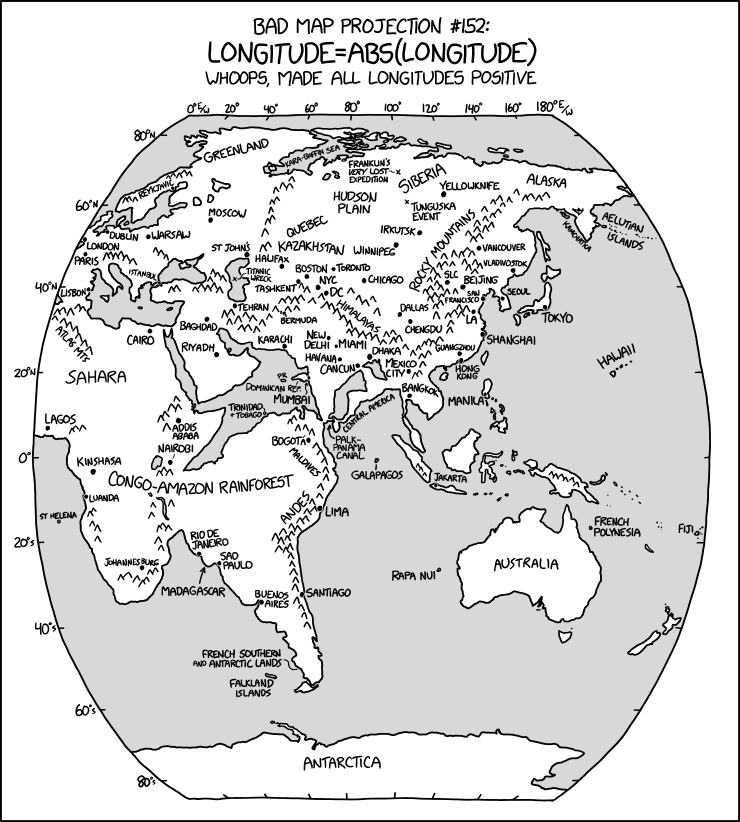
The latest in Randall Munroe’s Bad Map Projection series on xkcd is perhaps his most evil yet: it turns all longitudes positive—i.e., it turns west longitude into east longitude, putting Quebec somewhere in Kazakhstan and the Panama Canal off Sri Lanka.
Map Men on Why North Is Up
The latest episode of Jay Foreman and Mark Cooper-Jones’s all-too-infrequent series Map Men looks at why north is at the top of modern maps, and features examples of maps where this was, or is, not the case, and why.
For something a bit more … academic, see Mick Ashworth’s Why North Is Up: Map Conventions and Where They Came From (Bodleian, 2019).
Previously: The Origins of North at the Top of Maps; The Idea of North.

Review: Atlas of Design, Vol. 6
Late last year I received, as a review copy, the sixth volume of the Atlas of Design. Things being what they are around here, there has been somewhat of a gap between receiving it, reading it, and saying something about it. But it’s worth saying something about that volume now, and the Atlas of Design in general, for at least one small reason I’ll get to in a moment.
I’ve mentioned the Atlas of Design series before, but it’s worth introducing it properly. Published every two years since 2012 by the North American Cartographic Information Society, the Atlas of Design is powered by volunteer editors and contributor submissions. Nobody’s getting paid for working on or appearing in these volumes—though it must be said that many of these maps are commercial ventures (posters available for sale at the mapper’s website) or works for hire (National Geographic and the Washington Post are represented in volume six), so the mapmakers aren’t doing this just for the exposure.
Tien Shan and Other Panoramic Maps by Eric Knight

Eric Knight’s amazing panoramic maps aren’t the mountain panoramas you’re used to (if, that is, your point of reference is Berann or Niehues). Knight, who’s produced detailed relief and panoramic maps for National Geographic (see this page for examples of his work) gives us maps of vast regions, viewed in some cases from such a height that the Earth’s curvature is visible: see for example the Alps, the Caucasus, and Tien Shan (above). Available in online zoomable versions and for sale as prints. [Cartoblography]
Confused by Cartographic Conventions
Daniel Huffman writes that “there are certain cartographic conventions out there for which I don’t understand the logic.” (Such as that thematic or choropleth maps should be on equal-area projections.) “I do not suggest that these conventions are wrong; only that I lack a clear, intuitive rationale for following them, and so haven’t always incorporated them into my own practice. Maybe you can help explain them, or maybe you’re confused, too.”
In Praise of Dot Grid Maps

Mikel Maron is a fan of dot grid maps:
Dot grids are a clear, informative, multidimensional and flexible cartographic technique. They effectively leverage patterns of human perception to present information dense but readily comprehensible maps. Compared to choropleth maps, dots retain the base map context, and invite us to fill in the gaps. They emphasize the limits of data sampling. Dot grids can be joined together across different boundaries flexibly. The density of a dot grid can be varied depending on the scale. And that visual regularity … it just looks so cool.
He offers some examples of dot grid maps from his work at Earth Genome (see e.g above), and elsewhere, and gives some history of the format.
Ordnance Survey Soliciting Ideas for New Map Symbols
The Ordnance Survey is asking its users to propose new symbols for its paper and digital maps, the Sunday Times reports [paywalled; News+]. “The national mapping agency is suggesting a list of potential updates, such as cafés, dog-waste bins and bicycle repair shops, as well as annotations to alert wheelchair and pushchair users about paths that have stiles. It may also include defibrillators once there is a reliable register.” Symbols were last updated in 2015. The Times article quotes a number of people who point out that the OS map could stand more radical change: among other things, there are still no separate symbols for non-Christian places of worship. See also the Guardian’s coverage.
‘One Bad Map a Day in February’

It’s like the #30daymapchallenge in November, in which mapmakers are challenged to make a map a day on a given daily theme, only the reverse: the MapFailbruaryChallenge is about making a bad map on a given daily theme. “The idea is to create the worst map possible.” Bad maps happen; will a deliberately bad map be better or worse? Either way, it’s probably worth stocking up on popcorn for when maps with the #mapfailbruarychallenge hashtag start showing up on our timelines.
(Failbruary. Fai-EL-bru-AIR-y. Say that ten times. And resign yourselves to the fact that Reddit is probably going to kick everyone’s ass on this.)
Update, 19 Jan: There’s an official website now.
Projection Connections: A Genealogy of Map Projections

Fresh off of producing a (now sold-out) line of map projection trading cards, Daniel Huffman has produced a 16×24-inch poster showing the surprisingly close and entangled relationships between the various map projections.
I first learned about a couple of these connections several years ago. I don’t quite remember how or where, but I found out that the Mercator projection was equivalent to a Lambert Conformal Conic with the standard parallels set opposite each other across the Equator. And that if you moved both those parallels up to a pole, you got a Stereographic. My mind was suitably blown, and I saved it as a fun fact to share with people. This year, while working on The Projection Collection, I spent a lot of time on daan Strebe’s site looking up details, and I often saw his notes (usually derived from Snyder/Voxland) about how projections were related to each other. I started to realize there were a lot of these connections out there, and I thought it might be fun to diagram them in some way.
The diagram is digital-only (PDF) and donationware.