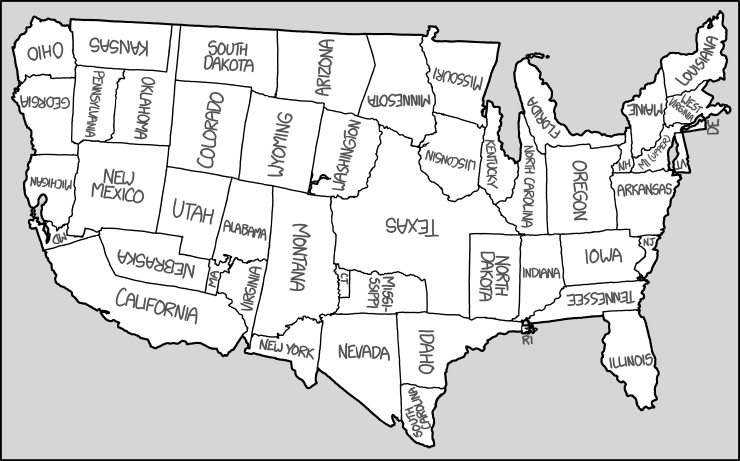
Emma Hart Willard, “Ninth Map or Map of 1826,” in A Series of Maps to Willard’s History of The United States (New York, 1829). Library of Congress Geography and Map Division.
On Cartastrophe, Daniel Huffman points out the problems in Decision Desk HQ’s interactive cartograms for the U.S. presidential primaries, which maintain a state’s shape but resize the counties as the results come in. “Unfortunately, in so doing, they shuffle the counties around any old which way. The Lower Peninsula of Michigan has 68 counties in reality, the Upper Peninsula has 15. But Decision Desk HQ has shoved most of the counties into the Upper Peninsula, which now has 58, vs. 25 that remain in the Lower Peninsula,” Huffman writes. “This means that we can’t really see spatial patterns, which is sort of the point of having a map.” [via]
There was a time, not too long ago, when our Super Tuesday map would have been impossible to put together and display. Even earlier in the digital era, a complete vote-totals map wouldn’t have been available until every ballot was counted at the end of the night. (Not to mention that in the print-only era, no map would be available until two days after the vote, and then often only in black and white.)
The New York Times graphics department invariably does first-rate work, and their interactive maps of the U.S. presidential primary and caucus results are no exception. You can zoom in, you can get results by county or congressional district (depending on the state), you can choose to view margin of victory (see screencaps below) or each candidate’s vote share.
FiveThirtyEight maps the Facebook likes of the U.S. presidential candidates: “If Facebook likes were votes, Bernie Sanders would be on pace to beat Hillary Clinton nationwide by a nearly 3-to-1 margin and Donald Trump to garner more support than Ted Cruz and Marco Rubio combined. Anything seems possible this year, but, still, be careful how you interpret these numbers: Facebook likes are not votes.” They ain’t kidding—Ben Carson?! [via]
Of the maps of the Democratic and Republican U.S. presidential primary and caucus results I’ve seen so far, I rather like the county-by-county maps done by Reddit user Mainstay17. Here’s one for the Democrats that includes the results from the Super Tuesday states:
For this exhibition, Scher has created a body of large-scale cartographic paintings focusing on the United States. Paintings as tall as seven feet depict the country swirling in torrents of information and undulating with colorful layers of hand-painted boundary lines, place names, and commentary. Different sets of data—population demographics, transportation flows, geography, and climate—are employed to make connections and establish patterns. While the information can in no way be interpreted as literal fact, the expression of it demonstrates a personalized understanding of the diversity of the United States.
Governing used interactive maps to measure the gentrification of the neighbourhoods of Boston (above) and 49 other cities as part of their report on gentrification in the United States last year. “While it has become much more prevalent, gentrification remains a phenomenon largely confined to select regions, not yet making its way into most urban areas. In the majority of cities reviewed, less than one-fifth of poorer, lower priced neighborhoods experienced gentrification. If all city neighborhoods are considered—including wealthier areas not eligible to gentrify—less than one of every ten tracts gentrified. Cities like Detroit, El Paso and Las Vegas experienced practically no gentrification at all.” [via]
We Are One: Mapping America’s Road from Revolution to Independence, an exhibition by the Boston Public Library’s Leventhal Map Center (it ran from May to November last year) is going on tour. First stop: Colonial Williamsburg. From March 2016 to January 2017 it will appear at the DeWitt Wallace Decorative Arts Museum in Williamsburg, Virginia. From the press release: “More than 30 unique objects from Colonial Williamsburg’s collections will be included in the exhibition, which were not shown when it initially opened at the Boston Public Library in May 2015. […] Many of the objects from Colonial Williamsburg’s collection to be seen in We Are One are on view for the first time or are rarely exhibited.” [via]
The New York Times maps the rise in deaths from drug overdoses. “Some of the largest concentrations of overdose deaths were in Appalachia and the Southwest, according to new county-level estimates released by the Centers for Disease Control and Prevention. […] The death rate from drug overdoses is climbing at a much faster pace than other causes of death, jumping to an average of 15 per 100,000 in 2014 from nine per 100,000 in 2003.” [via]
The National Geographic website has an interview with Richard H. Brown and Paul E. Cohen, authors of Revolution: Mapping the Road to American Independence, 1755-1783 (W. W. Norton, October 2015). In the interview, Brown says that “some of the best collections of Revolutionary War maps have been among the least used. Historians tended to use the same maps over and over again to illustrate their narratives. What we did is to take the opposite view. We wanted the maps to tell the story, so we picked maps that we thought would tell the story of the battles best.” Buy at Amazon (Canada, U.K.)
In 1879, surveyor (and future USGS director) John Wesley Powell proposed that the boundaries of future western states be determined by watersheds, in order to avoid water use conflicts. John Lavey takes this proposal to its logical conclusion, imagining a U.S. in which all 50 states follow watershed boundaries. Via io9.