Waldseemüller’s set of gores was widely reproduced, yet the example to be offered at Christie’s on 13 December was never cut out—which largely explains why it has survived for hundreds of years. If it had been pasted as intended, Wilson says, ‘wear and tear would surely have seen its demise in the intervening centuries.’
Instead of being cut up, this particular map was used as scrap for bookbinding. It ended up among the belongings of the late British paper restorer Arthur Drescher, who died in 1986 and whose family recently came upon the piece.
Here’s the auction listing. The auction will take place on 13 December; the gores are expected to fetch between £600,000 and £900,000.
Here’s a video of Steven Feldman’s informative and entertaining talk at FOSS4G in Boston last August: “Fake Maps, Very Dishonest” looks at the ways in which maps, through ignorance, incompetence or deliberate intent, can mislead, misinform, misfire and miss the point. Very much in the vein of Monmonier’s How to Lie with Maps, or Andrew Wiseman’s “When Maps Lie,” but very much aimed at working mapmakers. Slides of Steven’s presentation are available here (there are some that didn’t make it into the actual talk). Slides and videos of other FOSS4G presentations are also available online. [Benjamin Hennig]
Map of the Battlefield of Shiloh; Tennessee; Confederate Maps, 1861-1876; War Department Collection of Confederate Records, 1825-1927, RG 109; NACP—Cartographic (RDSC).
The Unwritten Record, a blog by staff at the U.S. National Archives’s Special Media Archives Services Division, announced last month: “Civil War maps are always popular at the National Archives, and the Cartographic Branch is pleased to announce the digitization of over 100 Confederate maps from Record Group (RG) 109. All are now available to view or download through our online catalog.” [Texas Map Society]
The William P. Cumming Map Society’s North Carolina Map Blog has a post looking at miniature maps of North Carolina (“miniature” is defined as less than four inches in size) and a post about minchiate, a 16th-century Florentine card game; there were were educational minchiate decks with a map on each of the 97 cards. [WMS]
Here’s a book that, given my interest in maps and literature, I’ll have to track down: Literature and Cartography: Theories, Histories, Genres, edited by Anders Engberg-Pedersen and featuring contributions from 15 other authors. “Literary authors have frequently called on elements of cartography to ground fictional space, to visualize sites, and to help readers get their bearings in the imaginative world of the text. Today, the convergence of digital mapping and globalization has spurred a cartographic turn in literature. This book gathers leading scholars to consider the relationship of literature and cartography. Generously illustrated with full-color maps and visualizations, it offers the first systematic overview of an emerging approach to the study of literature.” Out today from The MIT Press. [Amazon]
The future of mapping, according to John Hanke and Brian McClendon, who basically created Google Earth, is something called a semantic map. Now, semantic mapping has very different meanings in literacy, statistics and data science; in this case a semantic map refers to “a map that continues to learn about the physical world and refine its predictions of what objects are and how they will act through huge amounts of data. Without semantic maps, self-driving cars won’t ever be able to intelligently move through the world–at least not without crashing into something—a development that will arrive when self-driving cars do.” Also has augmented reality implications. The Co.Design article explains. [Dave Smith]
You Are Here NYC: Art, Information, and Mapping, an art exhibition at the Pratt Manhattan Gallery curated by Katharine Harmon and featuring maps in a similar vein to her 2016 book You Are Here: NYC (reviewed here), closed last week (my bad for not getting to it sooner), but in the interest of posterity, here’s Gothamist’s coverage.
Every year at about this time I post a gift guide that lists some of the noteworthy books about maps that have been published this year. If you have a map-obsessed person in your life and would like to give them something map-related—or you are a map-obsessed person and would your broad hints to have a link—this guide may give you some ideas.
Once again I’ve done my best to organize the books by theme. This is not a complete list of what’s been published in 2017. That’s what the Map Books of 2017 page is for: that page includes many, many other books that might also suggest themselves as gift possibilities.
Codex Quetzalecatzin, 1593. Manuscript map, 90 × 73 cm. Library of Congress.
The Library of Congress has acquired the Codex Quetzalecatzin, an extremely rare 1593 Mesoamerican indigenous manuscript that depicts, using Nahuatl hieroglyphics and pre-contact illustrative conventions as well as Latin characters, the lands and genealogy of the de Leon family. John Hessler’s blog post describes the codex and helps us understand its significance.
Like many Nahuatl codices and manuscript maps of the period it depicts a local community at an important point in their history. On the one hand, the map is a traditional Aztec cartographic history with its composition and design showing Nahuatl hieroglyphics, and typical illustrations. On the other hand, it also shows churches, some Spanish place names, and other images suggesting a community adapting to Spanish rule. Maps and manuscripts of this kind would typically chart the community’s territory using hieroglyphic toponyms, with the community’s own place-name lying at or near the center. The present codex shows the de Leon family presiding over a large region of territory that extends from slightly north of Mexico City, to just south of Puebla. Codices such as these are critical primary source documents, and for scholars looking into history and ethnography during the earliest periods of contact between Europe and the peoples of the Americas, they give important clues into how these very different cultures became integrated and adapted to each others presence.
The Codex has been in private hands for more than a century, but now that the Library of Congress has it, they’ve digitized it and made it available online. [Tony Campbell/Carla Hayden]
On 5 December Christie’s will auction, as part of a lot of printed books and manuscripts, a map described as “an important manuscript map of New York City prepared by cartographers attached to Rochambeau’s forces during the Yorktown Campaign.” The 63×40-cm ink-and-watercolour map dates from 1781-1782 and is expected to fetch between $150,000 and $200,000. Christie’s item description is quite detailed.
Olaus Magnus, Carta Marina, 1539. Detail. James Ford Bell Library.
In an article I published in 2013, I argued that one key difference between fantasy maps and the real-world medieval and early modern maps they purport to imitate is blank spaces: fantasy maps are full of blank spaces (that which is not in the story is not on the map), whereas real-world maps were covered in cartouches, sea monsters, inset illustrations and other embellishments. One of my sources for that article was a book by Chet Van Duzer: Sea Monsters on Medieval and Renaissance Maps (reviewed here).
Historians of cartography occasionally refer to cartographers’ horror vacui, that is, their fear or hesitancy to leave spaces blank on maps that might be filled with decorations. Some scholars have denied that this impulse was a factor in the design of maps, but the question has never been examined carefully. In this talk I will undertake such an examination, showing that horror vacui was indeed an important factor in the design of maps, at least for some cartographers, from the sixteenth to the early eighteenth century. Some of the factors that motivated cartographers’ concern about empty spaces will also be examined, as will maps by cartographers who evidently did not experience this fear. In the eighteenth and nineteenth centuries maps began to be thought of as more purely scientific instruments, cartographic decoration declined generally, and cartographers managed to restrain their concern about spaces lacking decoration in the interest of presenting their work as modern and professional.
But since I couldn’t make it to those events, all I had was that tantalizing abstract. (Publish something!) Fortunately, we now have a little more: Greg Miller has written a piece about Van Duzer’s research over on the National Geographic All Over the Map blog.
Eurasian reed warblers don’t need no stinkin’ marine chronometers. A new study suggests that the migratory birds make use of magnetic declination to determine longitude, “at least under some circumstances under clear skies. Experienced migrants tested during autumn migration in Rybachy, Russia, were exposed to an 8.5° change in declination while all other cues remained unchanged. This corresponds to a virtual magnetic displacement to Scotland if and only if magnetic declination is a part of their map. The adult migrants responded by changing their heading by 151° from WSW to ESE, consistent with compensation for the virtual magnetic displacement.”
Not, it would seem, accurate enough for the species to earn a chunk of the Longitude Prize, and it’s not like John Harrison should have been messing about with birds instead of clocks, but interesting all the same. [GeoLounge]
Presentations from NACIS’s 2017 annual meeting in Montreal were recorded and are now available on the NACIS YouTube channel. So if, like me, you weren’t able to attend, here you go. Next best thing.
A book I missed hearing about earlier: Bjørn Berge’s Nowherelands: An Atlas of Vanished Countries 1840-1975 (Thames and Hudson, October 2017). Another in the line of books about obscure, unusual and out-of-the-way places, this one focuses on countries that really did exist, but only for a little while. From the publisher:
Some of their names, such as Biafra or New Brunswick, will be relatively familiar. Others, such as Labuan, Tannu Tuva and Inini, are far less recognizable. But all of these lost nations have fascinating stories to tell, whether they were as short-lived as Eastern Karelia, which lasted only a few weeks during the Soviet–Finnish War of 1922, or as long-lasting as the Orange Free State, a Boer Republic that celebrated fifty years as an independent state in the late 1800s. Their broad spectrum reflects the entire history of the 19th and 20th centuries, with its ideologies, imperialism, waves of immigration and conflicts both major and minor.
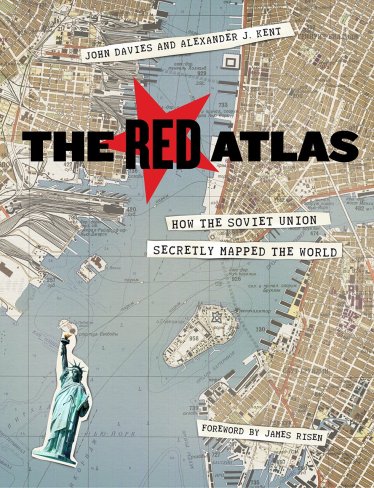
During the second half of the twentieth century, the Soviet Union’s military and civilian cartographers created topographical maps of the entire world of a very high standard of quality and accuracy. How they did so, and why, remains in large part a mystery, one that John Davies and Alexander J. Kent’s new book, The Red Atlas: How the Soviet Union Secretly Mapped the World (University of Chicago Press, October) fails to solve completely.
The Red Atlas is not the definitive history of those Soviet mapping efforts because so much about those efforts remains a secret. The only reason we know about them is because, in the wake of the collapse of the Soviet Union, so many physical copies of those once-highly secret maps fell into the hands of map collectors. The Red Atlas talks about that: for more than a decade, Davies and Kent have been studying those maps. (I’ve been following their work. See the links at the bottom of this post for my earlier posts on the subject.) What they know about the Soviet mapping efforts—sources, methods, their reason for doing it—is extrapolated from the final product of those effort: the maps. The Red Atlas is above all else an exercise in cartographic forensics.