
The May/June 2019 issue of Archaeology magazine looks at some truly ancient maps, many of which—tablets, papyruses, stick charts—challenge our ideas of what maps ought to look like.
Author: Jonathan Crowe
Jonathan Crowe blogs about maps at The Map Room. His essays and reviews have been published by AE, Calafia, The New York Review of Science Fiction, the Ottawa Citizen, Strange Horizons and Tor.com. He lives in Shawville, Quebec.
Pasha Omelekhin’s Berlin Transit Map

Among other things, Pasha Omelekhin’s redesign of the Berlin S-Bahn map brings the dog back: the Ringbahn’s route is roughly in the shape of a dog’s head, but in most Berlin transit maps since the 1930s it’s been shown as a circle. It also shows rivers and channels, and adds other curves to give Omelekhin’s unofficial map a flowing, organic look. [MetaFilter]
Happy GPS Week Rollover!
It’s probably overstating things to compare the GPS week rollover to the Y2K bug (The Next Web, The Verge) but it’s hard not to see some parallels. In each case, it’s a function of too little memory assigned to timestamps.
One of the things that GPS satellites do is transmit precise timing information. It does this in part by stating the week as a 10-bit integer, counting from week one. That means the date number rolls over every 1,024 weeks. Every 19.7 years, then, the GPS week “rolls over” and a new GPS epoch begins. It’s already happened once: the GPS era started on 6 January 1980, and the first rollover occured in August 1999. The next one takes place—oh dear—tomorrow. Cue the mass hysteria.
How will our GPS receivers respond to that rollover? Because it’s happened before, and because consumer GPS tech doesn’t necessarily stay in use for long periods of time, it’s unlikely that your or my GPS receivers are affected. Anything released in the past two decades would have programmed after the last rollover. Also, receivers might have have had an offset to the 1,024-week limit programmed into their firmware, starting the clock from the date of compilation rather than August 1999, so devices affected may not be affected all at once. U.S. government agencies note that GPS receivers that conform to the IS-GPS-200 specification should not be affected: PC Mag pins that on devices manufactured in 2010 or later.
My own legacy GPS receivers—a Garmin eTrex Legend H and an Oregon 450t—date from just before 2010, and while I haven’t used them in years (when your smartphone has built-in GPS, dedicated receivers are superfluous in the most common use cases), I’m half tempted to fire them up and see what happens. Both TomTom and Garmin claim that the vast majority of their devices are unaffected, but neither go so far as to give us a list of affected devices. Firmware updates are apparently being issued for some of those affected devices—but again, a list would help.
In any event, it appears that using GPS for location, even on an affected device, will not be broken: at worst your tracklogs will have inaccurate timestamps. Receivers that use GPS for accurate timekeeping that have not been updated to handle the rollover might run into some trouble, though. And, like Y2K, any problems might be in industrial or embedded systems rather than consumer tech—and from what I’ve seen online they’ve been getting warnings about this for years.
In other words, as far as I can tell, the GPS world will not come crashing down tomorrow.
Great Britain’s National Parks Poster

To mark the 70th anniversary of the legislation creating the United Kingdom’s national parks, the Ordnance Survey has released the above poster showing each of Britain’s 15 national parks in relief. The 84 × 119 cm poster can be had for £15 via the Ordnance Survey’s shop.
The Geography of Partisan Prejudice

The Atlantic maps political polarization in America. “The result was surprising in several ways. First, while virtually all Americans have been exposed to hyper-partisan politicians, social-media echo chambers, and clickbait headlines, we found significant variations in Americans’ political ill will from place to place, regardless of party.” Includes an interactive map with county-level data based on polling and analytics.
Search Results for Forgotten Towns
Online maps are giving ghost towns a new life, of sorts. The Daily Southtown’s Ted Slowik looks at the case of Gilletts, Illinois, a forgotten milk stop on the Rock Island line. But thanks to its listing in the USGS’s Geographic Names Information System and the fact that it’s surrounded on all sides by medium-sized cities and towns, doing a search on Gilletts generates all kinds of results.
Shopping for a new home? A search on Zillow produces 12 results of homes for sale near Gilletts. Trulia, another real estate website, generates 84 results.
Searching for a job? The website Indeed shows 718 employment opportunities within 5 miles of Gilletts. Another site, Simply Hired, shows 563 jobs available within 5 miles of Gilletts.
You can find Gilletts on Mapquest. You can get the forecast for Gilletts on AccuWeather’s website. If you’re looking for a hotel room, Booking.com can show you more than 70 rooms available and their distance in miles from downtown Gilletts.
Except there is no downtown Gilletts, since it was never anything more than a depot where trains stopped to pick up milk that local farmers sold to markets in Chicago and elsewhere.
But according to Yelp, there are 115 places to eat, 233 things to do and 353 places to shop within striking distance of Gilletts.
The same is no doubt true with any named point on the map, and to be honest this is probably how it should be. Web services are providing results based on proximity to a given location: there’s no judgment about the significance of that location. You’re the one who put the ghost town’s name into the search engine: here you go.
An Exhibition of Historic Maps of New York City: New Amsterdam to Metropolis
Untapped Cities has photos from an exhibition of historic and antique maps of New York City at the gallery of Manhattan rare book dealer Martayan Lan. New Amsterdam to Metropolis: Historic Maps of New York City features maps of the city dating back to the 16th century. It opened last November and runs until the end of May 2019. Some (but not all) of the maps, the New York Times notes, are for sale, which is what happens when it’s a rare book dealer rather than a museum or library doing the exhibition.
xckd’s ‘Least Informative’ Google Trends Maps
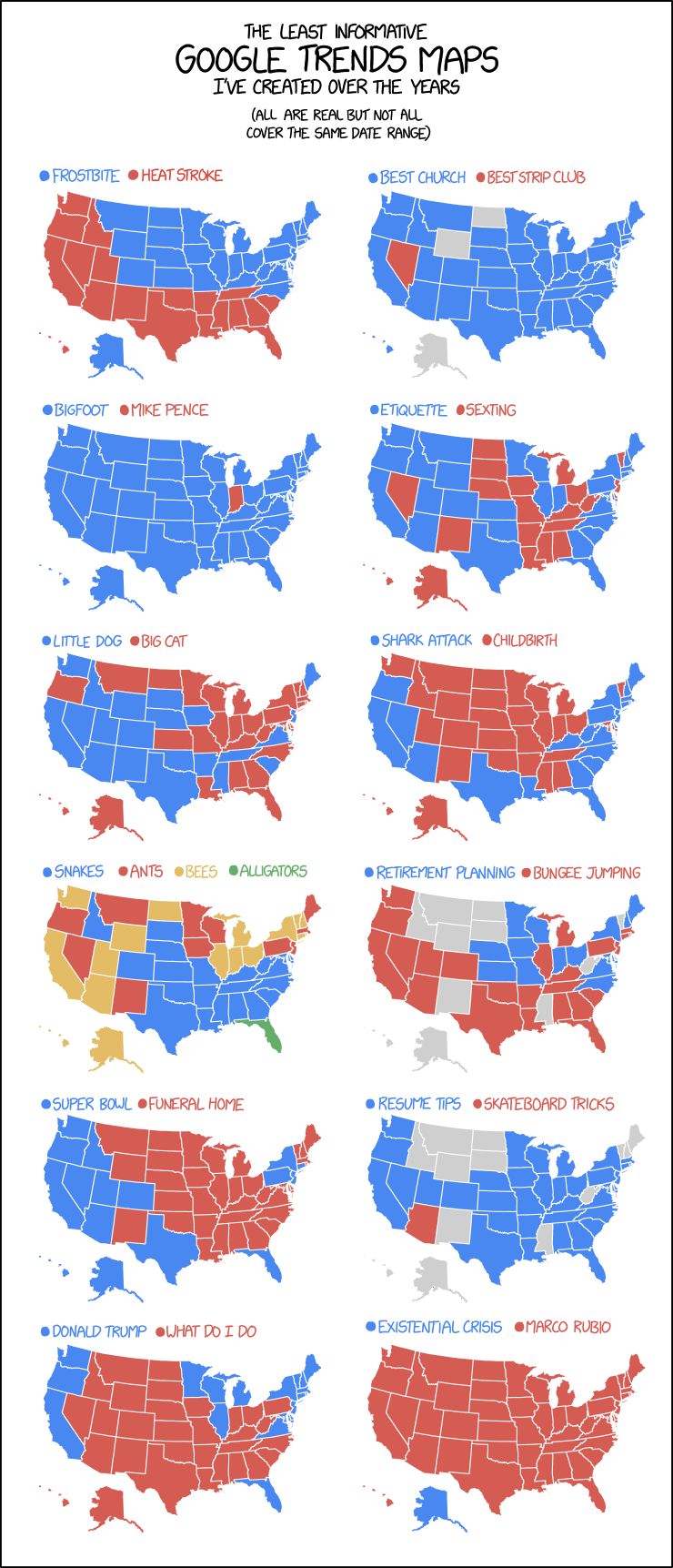
Oh look, another map-themed comic/infographic thingy from xkcd: the March 20 edition is having some fun with the maps generated by Google Trends data. The maps are real, says Randall.
Priscilla Spencer, Fantasy Mapmaker



I’m impressed by the work of fantasy mapmaker Priscilla Spencer, whose maps have illustrated novels by Seanan McGuire, Myke Cole, Jim Butcher and Saladin Ahmed, among others. Spencer’s maps push the boundaries of the default fantasy map style: some of them appear as they would in-universe, others adopt elements appropriate to the culture of the world being mapped. Making a note for future reference.
A Map of Modern-Day Westeros

Art designer James Shadrach Schoenke imagines a modern-day Westeros with a modern-style map that mimics the design of European road maps.
Using Street View to Spot Gentrification
CBC News: “A group of researchers at the University of Ottawa is using Google Street View to spot instances of gentrification in the city’s neighbourhoods. […] The program looks for patterns of improvements on individual properties, such as new fences, landscaping, siding or significant renovations.” Honestly not something for which I expected Street View to have a use.
What Does a Fantasy Map Look Like?
New from me on Tor.com this morning: “What Does a Fantasy Map Look Like?” This is the first of several planned pieces that will take a deep dive into the look and feel of fantasy maps: their design and aesthetic, their origins and inspirations, and where they may be going in the future. In this piece, I start by trying to describe a baseline fantasy map style—which, though it’s well recognized and often imitated, has not often been spelled out.
AM New York on the NYPL Map Division
Meanwhile, AM New York takes a look at the holdings of the New York Public Library’s Map Division.
Osher Map Library TV Segment
News Center Maine, the news wing of Portland, Maine NBC affiliate WCSH, has a segment profiling the Osher Map Library.
‘Last Week Tonight’ Solves the Missing New Zealand Problem
 On Last Week Tonight’s 17 February episode, host John Oliver took a moment to look at how New Zealand keeps getting left off world maps—the case of IKEA’s map poster being the most recent example. They are nothing if not helpful: as a solution, the show’s Twitter account has posted a cutout map of New Zealand to print and paste on any map that has left it off.
IKEA’s going to need extra security.
New Zealand media is all over this: New Zealand Herald, RNZ, TVNZ.
Previously: IKEA Map Poster Omits New Zealand; New Zealand Launches Campaign to Get Itself Back on World Maps; Maps Without New Zealand.