
 Also from Birlinn, The Railway Atlas of Scotland: Two Hundred Years of History in Maps by David Spaven, which came out last October.
Previously: British Railways, Past and Present.
Also from Birlinn, The Railway Atlas of Scotland: Two Hundred Years of History in Maps by David Spaven, which came out last October.
Previously: British Railways, Past and Present.
 The National’s Alan Taylor reviews Glasgow: Mapping the City by John Moore (Birlinn, October 2015), an illustrated book of maps of the city dating back to the 16th century (via). This is one of several map books published by Birlinn that cover the history of Scotland in maps: previous volumes include Edinburgh: Mapping the City by Christopher Fleet and Daniel MacCannell (2014) and Scotland: Mapping the Nation by Christopher Fleet, Charles W. J. Withers and Margaret Wilkes (2012).
 Gretchen Peterson reviews the second edition of Cynthia Brewer’s Designing Better Maps: A Guide for GIS Users (Esri Press, December 2015). “I’d say it’s much better than the previous edition. All the images have been updated and are now in keeping with modern cartography practices. All the typical things that you need to know are covered from fonts and labels to color and layout.” Buy at Amazon (Canada, U.K.)
At about this time of the year I assemble a gift guide that lists some of the noteworthy books about maps that have been published this year. It’s by no means a comprehensive list, but if someone in your life is just a little bit obsessed about maps (and if you don’t have such a person, why don’t you?), and you’re looking for something to get them, this list might be of use.
Some of these books you’ve seen me blog about before; others I’m mentioning for the first time.

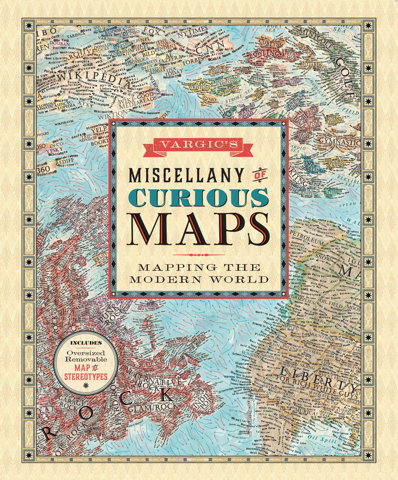 In January 2014 a teenage design student from Slovakia named Martin Vargic posted a map of the Internet—inspired, he told The Independent, by the xkcd classic—on his DeviantArt page. The map quickly went viral. Since then, he’s been producing maps of all sorts of things—a revised Internet map, a literature map, historical maps, maps of the world after global warming and an ice age, a stereotype map (see previous entry), plus other infographics—at a dizzying pace, most of which are available for sale on his website. Now his maps are being collected in a book, Vargic’s Miscellany of Curious Maps. It’s out now in the U.K. from Penguin imprint Michael Joseph; in North America it’ll be available in December from HarperCollins. Did I mention he’s a teenager?
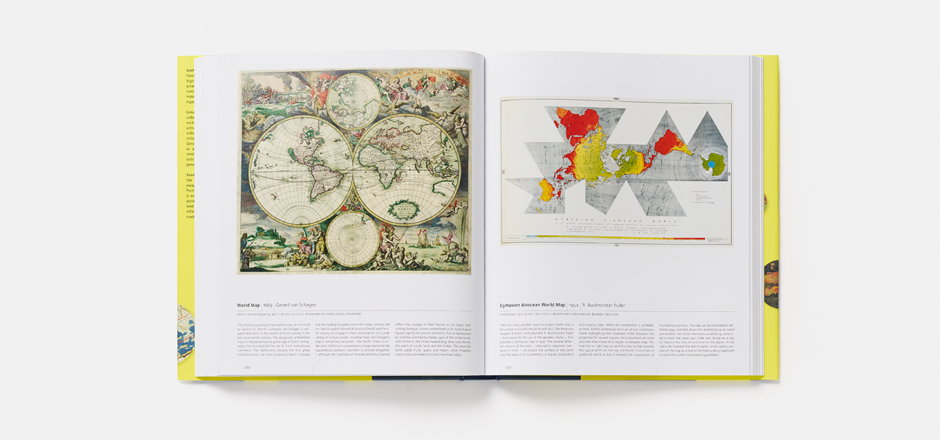
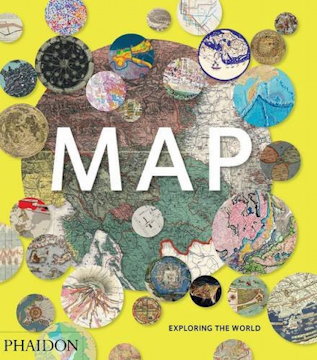 The run-up to every holiday season produces a fresh batch of lavishly illustrated map books, and this year does not appear to be an exception. Map: Exploring the World, a collection of “300 stunning maps from all periods and from all around the world,” came out last month from Phaidon Press. The book was assembled by “an international panel of cartographers, academics, map dealers and collectors,” the publisher says; Forbes contributor Bruce Dorminey’s look at this book reveals that one of them was Library of Congress map curator John Hessler.
 The first thing to keep in mind about Olivier Le Carrer’s Atlas of Cursed Places (Black Dog & Leventhal, October 2015) is that it’s not an atlas. Rather, it’s a collection of brief essays about a series of unique places around the world. In that I suspect it’s much like Judith Schalansky’s Atlas of Remote Islands or Aude de Tocqueville’s Atlas of Lost Cities (English translation forthcoming next year). All of these books shared a publisher in France; all of them appear to have been conceived under the influence of Calvino.
The Atlas of Cursed Places’s essays are about places in the world that are, for one reason or another, particularly horrible, by dint of their history or geography. There are navigational hazards and environmental disasters, and sites of old horrors that were entirely human-made. Ghost towns, war zones, slums and mausoleums. Animal infestations. Each are engrossing, but the essays barely get started on their subjects: turn the page expecting more and you find yourself already on the next one. Each essay is an act of cruelty (very meta given the subject matter), whetting readers’ appetites but denying us the feast.
In the end this is an exercise in curation: the choices are fascinating, but the essays are affective rather than substantive. In that sense this book is an even lighter read than Alastair Bonnet’s Unruly Places (which seems to have much less Calvino in its book DNA).
(While not an atlas proper, this book does have a lot of maps illustrating each essay. But their effect is disorienting: each cursed place is indicated by a star on an old and out-of-date map, usually a plate from a century-old atlas.)
I received an electronic review copy of this book from the publisher via NetGalley.
 A revised and expanded edition of Mark Ovenden‘s Transit Maps of the World is coming out in early November, presumably because the transit systems, and the maps thereof, have also been revised and expanded since the first edition was published in 2007. (My review of the first edition is here.) It’s being published by Penguin in the U.S. and Particular Books (a Penguin imprint) in the U.K. [Amazon]
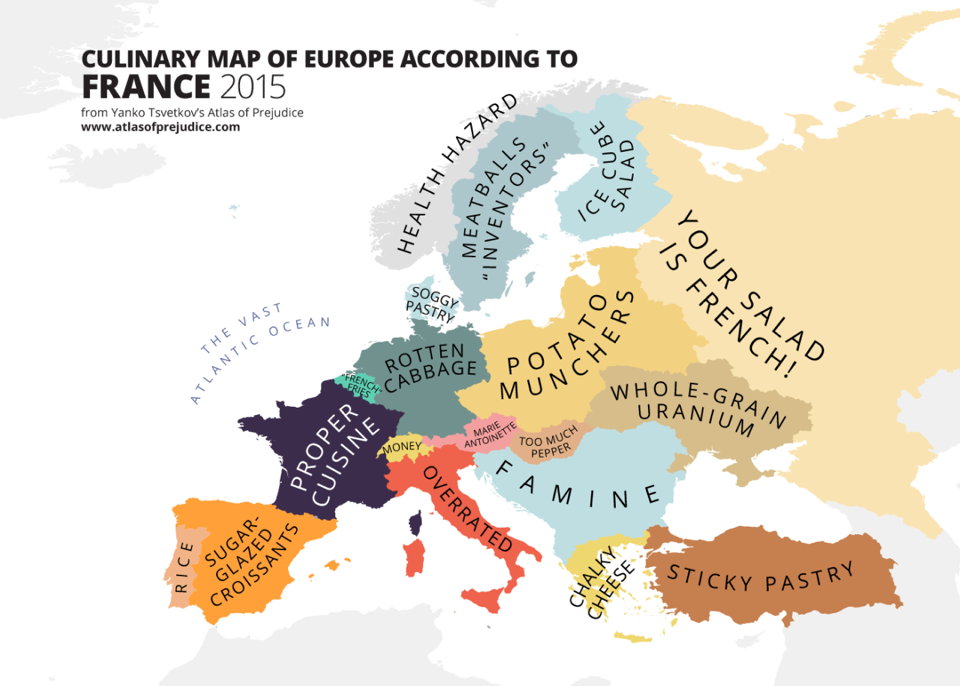
Back when I was doing The Map Room, I followed along as Yanko Tsvetkov started producing map after map of European stereotypes. The project really took off. He’s kept at it since, while I wasn’t looking quite as closely; he’s also collected them into two self-published volumes called the Atlas of Prejudice, which appear to have sold rather well in several different languages. As of July, an all-in-one edition, Atlas of Prejudice: The Complete Stereotype Map Collection, containing all the maps from the previous volumes plus 25 more, is now available.
Previously: Yanko Tsvetkov’s Beloved Europe; Mapping European Stereotypes; Stereotype Maps of the World, Unite!
 A new book of map art is due out from Gestalten later this month. Mind the Map, edited by Antonis Antoniou, Robert Klanten and Sven Ehmann, seems very much in the same vein as their previous effort, A Map of the World. “Mind the Map is a showcase that reflects the broad range of work now being created by a new generation of mapmakers from around the world including classically legible maps, artistic experiments, editorial illustrations, city views, vacation guides, and global overviews.” The Guardian has some samples, as does the publisher’s catalog page.
Previously: The World According to Illustrators and Storytellers.
 Coming in October from Zest Books: Andrew DeGraff’s Plotted: A Literary Atlas, a collection of the artist’s maps of fictional worlds. The Huffington Post has an interview with the author and sample pages from the book, from which we can get a sense both of DeGraff’s distinct and idiosyncratic artwork and the books he chose to make maps for. They’re not necessarily books you’d expect maps for (e.g., A Christmas Carol). These are maps of the stories—not, as we see in fantasy maps, of the stories’ setting—which means a completely different perspective that takes into account both time and distance travelled.
Previously: Two Books on WWI Maps.

The sixth volume of the massive History of Cartography Project, Cartography in the Twentieth Century, is now available. Edited by Mark Monmonier, it takes two physical volumes and nearly two thousand pages to cover mapmaking in the twentieth century—and lists for an eye-popping $500 (U.S.), though it’s a bit cheaper on Amazon.
Volumes one through three are available for free download. Volumes four and five, covering the European Enlightenment and the nineteenth century, respectively, are still in development.
Previously: History of Cartography Project Co-Founder Dies.
 Alastair Bonnett’s Unruly Places (first published in the U.K. as Off the Map) is a light, entertaining exploration of some of the world’s more unusual places. Bonnett, a social geography professor at Newcastle University, has written 47 short essays about locations that, in the grand scheme of things, don’t make any sense: the exceptions, the asterisks, the ink blots (in at least one case literally) on the map.
These range from the deeply frivolous to the profoundly injust: from bits and pieces of New York City transformed into environmental time capsules and art projects to places meaningful to the author; from rendition sites and pirate bases to Bedouin settlements in the Israeli Negev desert; from destroyed landscapes to Potemkin cities. The places often feel almost science-fictional; and in fact several of them evoked settings in existing science fiction works, like Christopher Priest’s Dream Archipelago and Maureen McHugh’s Nekropolis.
All in all, a pleasant diversion for the geographically minded, though I did have one quibble: the book calling latitude and longitude “Google Earth coordinates,” as though degrees are as proprietary as limited to the KML format.
 I only just now found out about the new edition of Canadian Geographic‘s Atlas of Canada—via an item broadcast on CTV yesterday—or I would have included it in this year’s gift guide. It’s apparently the first new edition in a decade. (Incidentally this should not be confused with the Canadian government’s online Atlas of Canada, an entirely distinct beast.)